How MITI Supports You
Maricopa IT Institute (MITI) manages IT workforce programs from start to finish, working with industry partners and leveraging all ten Maricopa Community College programs. We guide you from education to internships and into careers. Connecting you with the skills, experience, and employers you need to succeed.
Internships
Internships bridge the gap between classroom learning and the fast-paced tech industry. Gain the practical skills, industry connections, and confidence you need to stand out in IT.
We highly encourage any student to get their Workforce Professional Skills badge. It’s a microcredential that encompasses foundational training in Key Performance Indicators (KPIs), virtual meeting etiquette, and public speaking, further strengthening the application of core professional skills. It’s free, and employers are looking for students that have this badge.
Eligibility Requirements:
- Minimum 2.5 GPA
- Currently enrolled
- Not in their first semester
- Resume required
How to Get Started:
- Fill out the Student Internship Application Form.
- We’ll connect you with organizations seeking IT interns.
- Gain the experience you need to thrive in today’s tech-driven world.
IT Program Pathways and Average Career Salaries
*Salary figures reflect 2025 data from the U.S. Bureau of Labor Statistics
IT Fundamentals
Courses: CIS101
Computer User Support Specialist – $55,190
Maintenance & Repair Worker (General) – $46,700
Health Technologists & Technicians (All Other) – $47,470
Cloud Computing (AWS)
Courses: CIS105, BPC170, BPC270, CNT140, CNT150, CLD110, CLD120
IT Support Specialist – $61,550
Help Desk Technician – $61,550
Technical Support Specialist – $61,550
Desktop Support Technician – $61,550
Network Technician – $61,550
Junior Network Administrator – $49,000
Infrastructure Support Technician – $92,000
JAMF (Apple Device Management)
Courses: BPC265, CIS290AC → CIS298AC, Non-Credit
Information Security Analyst – $124,910
Computer Systems Analyst – $103,800
Computer Network Support Specialist – $103,800
JAMF Certified Technician – $78,384
Python Applications
Courses: CIS150AB, CIS156, CIS256
Junior Python Developer – $98,670
Data Analyst (Python) – $131,450
QA/Test Automation Engineer – $131,450
Software Support Specialist – $52,270
IT Technician with Scripting – $61,550
Cyber Microcredentials
Courses: CIS102DA, CIS105, CIS126DL, CIS126RH, CIS190, CNT140AB, BPC170, BPC270
Junior IT Support Technician – $61,550
Technical Support Technician – $61,550
Networking Computer Systems Administrator – $96,800
Stories

Addison Walkosz
MCC was the perfect choice when Addison decided to major in psychology. It remained the perfect choice when he switched majors to game technology. “I decided MCC was best instead of going straight to a university for the time being,” he explains… Read more about Addison Walkosz
Addison Walkosz
For those who think that what they’re studying won’t be good enough or important enough, remember that what you’re doing should matter to only one person–yourself...Be successful for you.
MCC was the perfect choice when Addison decided to major in psychology. It remained the perfect choice when he switched majors to game technology. “I decided MCC was best instead of going straight to a university for the time being,” he explains. “I wanted to start out a bit smaller and work towards my goals one step at a time instead of being thrown onto a big campus.”
Addison earned a Certificate of Completion in iOS during the Spring 2021 semester. “It was such a fun goal to accomplish,” he says, adding that MCC has given him the skills and knowledge to create his own apps, code in different languages and be successful in his field of study.
Today, he works at studioNAITO, a company based in San Francisco that produces multiplayer role-playing games. His responsibilities are working on server-side functions and designing new features. “I work with Xcode/Swift as well as a simple Swift-like language called Wren.”
One of the MCC faculty members who made a lasting impression on Addison was Prof. Dave Levy, one of his first instructors. “No question about it. Prof. Levy made it a high priority to help me succeed in his introduction to iOS development course. He took the time to get to know me and sat down with me numerous times which I will never forget,” he adds. “If it weren’t for him, I don’t think I would have ever gotten into app development as heavily as I have.”
Based on his positive personal experiences at MCC, the Valley resident has some advice for current and potential MCC students. “For those who think that what they’re studying won’t be good enough or important enough, remember that what you’re doing should matter to only one person–yourself,” Addison noted. “Be successful for you. You only need to prove to yourself that you could do what you told yourself you could.”

Hannah Cheloha
The U.S. Equal Employment Opportunity Commission finds that only 36% of women are in IT careers. Then there’s Hannah Cheloha, a woman who codes and builds apps and does so with a social conscience.
Earning a micro certificate in iOS App… Read more about Hannah Cheloha
Hannah Cheloha
iOS App Coding
MCC prepared me for success and provided the resources and opportunities to put my IT education and theories into practice.
The U.S. Equal Employment Opportunity Commission finds that only 36% of women are in IT careers. Then there’s Hannah Cheloha, a woman who codes and builds apps and does so with a social conscience.
Earning a micro certificate in iOS App Coding from Mesa Community College during the fall, spring and summer 2018 semesters when she was one of the first students to enroll in the Apple Everyone Can Code course, she returned in fall 2020 through fall 2021 for an app building internship.
She credits the learning opportunities offered at MCC and her instructors for her success as an American Sign Language (ASL) lecturer and ASL program coordinator at Arizona State University. “There is no doubt that I would not have been the preferred candidate if not for my IT and online teaching experience,” she says. “ MCC prepared me for success and provided the resources and opportunities to put my IT education and theories into practice.”
Hannah notes that Michael Bogner, MCC Computer and Information Systems faculty, reached out to her about the three-course internship program at the college designed to help students with app coding skills get real world experience. “The program established what could be described as an app boutique that partners with the Mesa Chamber of Commerce to connect businesses with student interns to build apps for businesses,” Hannah explains.
One of the first apps the interns created was Reach Out AZ connecting students with mental health and suicide prevention services for Mesa Public Schools.
Hannah also worked with her classmates and MCC faculty to develop the RISE (Resources, Information, and Services for Everyone) app as a pro-bono development operations manager and coder. The app connects Maricopa County Community College District students and students within other community college and higher education institutions nationwide with resources for free and modestly priced food, housing and healthcare.
As a final project for her internship, Hannah built an American Sign Language (ASL) dictionary app which became a companion app for her open education resource website, ASLInteractive. The website, for ASL students and interpreters, provides access to the dictionary and a variety of courses.
Hannah explained that at the time of her internship there was not much available for teaching ASL online so she worked with colleagues to build online materials to supplement existing materials. “I taught myself Wordpress, Final Cut Pro, basic html and other technologies for website building. When MCC offered the iOS app building courses I saw the sequence as the perfect opportunity to move my resources into the mobile assisted language learning arena.”
Her talent for app development has received national attention, specifically from Apple CEO Tim Cook. In 2020, Hannah was invited by Apple to attend a White House virtual event to share her experience with the Everyone Can Code program. She was also recognized a second time by the White House for her work on the RISE app.
To help narrow the gap between young girls and careers in STEM, Hannah has assisted MCC in its efforts toward this goal. She has volunteered with Girls Get IT, an MCC-sponsored event to facilitate a workshop for high school girls interested in STEM careers. “It was fun and rewarding to see young women excited about coding and technology and working together to problem solve and innovate.”

Jason Carter
In the weeks and months following the Covid-19 outbreak, Jason Carter was approaching the end of his schooling and was feeling that “everything was in disarray. I didn’t really know what to do,” said the Mesa Community College Computer… Read more about Jason Carter
Jason Carter
The Technopreneur experience gave me a professional work environment and helped me anticipate what to expect when I start working in information technology
In the weeks and months following the Covid-19 outbreak, Jason Carter was approaching the end of his schooling and was feeling that “everything was in disarray. I didn’t really know what to do,” said the Mesa Community College Computer Information Systems alumni.
The Phoenix resident had already completed an Associate of Arts degree in 2001 from Paradise Valley Community College and a Certificate of Completion in Web Development in 2019 from Scottsdale Community College.
Then, while attending MCC in 2020 as one of the first students to enroll in the Apple Everyone Can Code class, he was selected for the Pendergast School District Internship program the college offers that could give him real world experience using his app coding skills. While in the three-course “Technopreneur” program, Jason spent much of the time assisting MCC IT staff with the transition to the new school year including inspection of staff and student equipment, software updates, teacher laptop updates, repairing faulty equipment, and making other miscellaneous repairs and updates in Jamf, an industry-leading Mac management tool for Apple devices.
The internship also offered what could be described as an “app boutique,” a partnership with the Mesa Chamber of Commerce, to connect businesses with student interns to build apps promoting local businesses and providing additional hands-on training for students. One of the first apps Jason helped develop was designed to connect middle school students with mental health and crisis prevention services. A local public school system has expressed interest in adopting the app for its use.
“The Technopreneur experience gave me a professional work environment and helped me anticipate what to expect when I start working in information technology,” he explained. “The Apple App development program has provided additional experience that I can use in starting my new technology career.”
Jason went on to earn a Certificate of Completion in iOS App Development in 2022 from MCC.
He remains involved in development of the crisis prevention and Jarrod’s Coffee House apps.
“Eventually I would like to be a developer for software applications or the web,” he said. “I'm also interested in establishing a web development/digital marketing business.”

Karl McPhee
As a software developer 1 at Uber Eats, now living in New York City, Karl McPhee focuses on backend development and machine learning–sophisticated skills he learned as a Mesa Community College student and intern.
“At the time I started… Read more about Karl McPhee
Karl McPhee
MCC’s app design program was one of the best opportunities I could have had for getting that experience in moving from coding small projects to full application design.
As a software developer 1 at Uber Eats, now living in New York City, Karl McPhee focuses on backend development and machine learning–sophisticated skills he learned as a Mesa Community College student and intern.
“At the time I started taking courses at MCC, I was enrolled in Arizona State University’s Master of Science program and had experience with programming in Java and Python,” said Karl. “I was drawn to the interesting course content and focus on modern technologies and programming languages like Swift.” MCC’s courses were the first practical experience he had with mobile development and database integration, as well as with working as part of a Sprint team.
Also influential in his career success was his MCC internship experience on a capstone project focusing on the mobile app development of ReachOutAZ, an app designed to help troubled teens. The Mesa Chamber of Commerce/MPS reached out because of a high need to support the student population in Arizona. Their desire was to connect students with mental health and support services. Karl developed the base edition of the Android version.
During early planning collaborations discussing goals and features for ReachOutAZ, interns and faculty discussed design and ways to make it useful for elementary and high school students as well as other design concerns. “This helped put into perspective for me just how complicated the process of app design is and how much planning and architectural design is involved,” he added.
Karl credits the MCC internship experience with helping him secure interviews at several high profile companies, including Meta, Google, Uber and Apple. “The interviewers I spoke with wanted to hear about real-world application development, particularly for businesses, as well as group collaborative efforts. Many of the skills that the ReachOutAZ project centered on, like Git and integration with cloud services, are also currently in high demand by businesses right now and were brought up in many of my interviews.”
Three faculty members in particular made a significant impact on Karl’s education: David Levy, a former lead iOS developer and Computer Information Systems faculty Deb LaVergne, Ed.D. and Michael Bogner, who invested much time and effort into making courses on modern application design ideal for both new and returning programmers.“Prof. Bogner coordinated and organized efforts over months, helping students find particular areas they were interested in working on and coordinating efforts between our Sprint team and the businesses and schools we worked with,” he continued. “I’m grateful for their work in making coding more accessible for all the new engineers out there.”
From his experience Karl has this advice to potential Thunderbirds: "Two important things that the software industry is currently looking for among entry-level developers – degrees and experience in developing applications. The first shows commitment and success in learning programming design concepts and the second shows impact and helps you stand out. MCC’s app design program was one of the best opportunities I could have had for getting that experience in moving from coding small projects to full application design.”

Karri Sisson
As a software developer at Glendale Community College (GCC), Karri Sisson believes in continuous learning. “Any programming class improves your skills as a developer because you can always pick up new concepts or ways to apply them to your… Read more about Karri Sisson
Karri Sisson
Pegasystems Certified System Architect (PCSA)
Even though I attended the class 100% remotely, the labs were set up so that I could access them and practice any time I had internet access, no matter where I was.
As a software developer at Glendale Community College (GCC), Karri Sisson believes in continuous learning. “Any programming class improves your skills as a developer because you can always pick up new concepts or ways to apply them to your current work,” she says.
So, when Sisson first heard about Pega Systems Architect Essentials, she was intrigued.
Wanting to learn more, Sisson tried to learn the program on her own, but after a few modules, she realized it would be best to enroll in a class and chose Mesa Community College’s fast-track Pega certification program.
“Having a live instructor available to ask questions during lectures and help guide me through the hands-on labs really made the difference,” she said. “Even though I attended the class 100% remotely, the labs were set up so that I could access them and practice any time I had internet access, no matter where I was.”
The Pegasystems Architect Essentials course prepares students to take the Pega System Architect Certification exam and become a Pega Certified System Architect (PCSA). However, as Sisson explains, the exam isn’t so easy.
“This was one of the hardest IT certification exams I have ever taken,” said Sisson. “You can’t just have a basic knowledge of Pega. You have to be able to take that knowledge and apply it. Just knowing how to build an app in Pega will not be enough to pass the exam and just having the classroom lecture knowledge is not enough. You have to fully understand and apply what you learned in class to the app building, which is achievable by understanding the processes that are happening as you practice in the labs.”
By the end of class, Sisson says she understood why so many companies have moved to a Pega architecture for building customer-facing apps and forms.
Now that Sisson is a Certified Pega System Architect, she will join her MCC instructor, Michael Bogner in teaching the Pega System Architect Essentials class at MCC, while maintaining her current position at GCC.

Omar Alaa
Motivation comes naturally for this teen who began his academic career at Mesa Community College when he was just 13 years old, while attending middle school at Sequoia Charter School in Mesa. At first the eighth-grader was unsure about attending… Read more about Omar Alaa
Omar Alaa
Associate of Applied Science, Programming/Systems Analysis, Certificate of Completion, App Development
MCC has helped me see other types of work in my field that I might be interested in. I've learned so much--much more than I ever thought I would and I am thankful for the time I spent at MCC.
Motivation comes naturally for this teen who began his academic career at Mesa Community College when he was just 13 years old, while attending middle school at Sequoia Charter School in Mesa. At first the eighth-grader was unsure about attending college at such a young age but he quickly realized he could handle the rigorous college coursework in addition to his middle school classes and, subsequently, his high school studies.
Starting on a full-time basis in Summer 2018, Omar graduated from MCC, having earned an Associates degree in Applied Science in Programming/Systems Analysis, and high school, with a 3.8 GPA and an award for exceptional academic achievement, in May 2021 at 15 years old. He also earned an App Development Certificate of Completion and an iOS App Development Certificate from MCC.
Omar credits many of his professors with helping him adjust to college coursework and develop a strong work ethic. “MCC has helped me see other types of work in my field that I might be interested in. I've learned so much--much more than I ever thought I would and I am thankful for the time I spent at MCC,” he said.
He gives this advice to current and incoming Thunderbirds: “MCC truly cares about education and teaching students from any background. Staff and faculty are willing to lend time and help you reach your goals. If you truly care about your education, you should take this opportunity.”
After being awarded a $100,000 scholarship from College Bound Arizona, a non-profit community resource for aspiring, under-represented students, Omar is now enrolled at Arizona State University pursuing a Bachelor’s degree in Software Engineering.
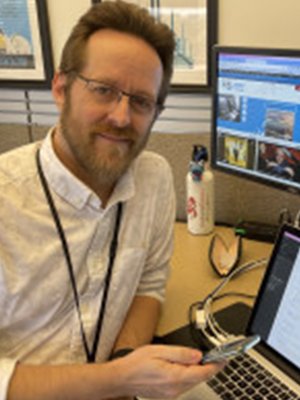
Patrick Wheeler
Choosing to modify his career path from television production to programming was a no-brainer for Patrick. While the industry was converting to computer-based technology, he became increasingly attracted to the way mobile devices, with their… Read more about Patrick Wheeler
Patrick Wheeler
Technopreneur Program and Certificate of Completion, AWS Cloud Practitioner, Web App Development, iOS App Development
I have been fortunate to be allowed to follow my interest in UI/UX design, and make my contribution developing the user experience, designing the graphical interface elements and building the working wireframe prototype in Xcode.
Choosing to modify his career path from television production to programming was a no-brainer for Patrick. While the industry was converting to computer-based technology, he became increasingly attracted to the way mobile devices, with their combined technologies, could perform tasks that were unimaginable at the time.
Patrick made the move to MCC and the Maricopa Information Technology Institute (MITI) to pursue design and gaming with a focus on mobile development and he’s happy he did–it provides an opportunity to develop technology that can potentially have a meaningful impact on local communities. Partnering with the college and the Mesa Chamber of Commerce, Patrick and his teammates are developing an app that provides crisis support to students and teens when life-changing or traumatic events occur in their lives. As an example, he cites the pandemic as a time when many students felt isolated during the many months of remote learning.
“I have been fortunate to be allowed to follow my interest in UI/UX [User Interface/User Experience] design, and make my contribution developing the user experience, designing the graphical interface elements and building the working wireframe prototype in Xcode,” he says.
Patrick’s time at MCC/MITI has been transformative. Pairing his production experience with UI/UX design experience plus three new Associate of Applied Science degrees in programming and numerous Certificates of Completion, he has launched a new career as a web and mobile software developer this year with Rio Salado College.
Connect With Us
Connect With Us
Director
480-731-8782
[email protected]
Workforce Navigation Analyst
[email protected]
MITI Program Coordinator
[email protected]